Summary
Content Summary: IECC 2024 Enhanced Building Thermal Envelope Credits
Master the new IECC 2024 Section R408.2.1.1 requirements with this comprehensive guide to Enhanced Building Thermal Envelope Performance in Rescheck. Learn how reducing total thermal conductance (UA) through superior insulation and high-performance glazing can earn your project critical energy credits.
Key Takeaways for IECC 2024 Compliance:
Thermal Conductance Defined: Understand how Rescheck calculates UA (U-factor × Area) to measure heat flow.
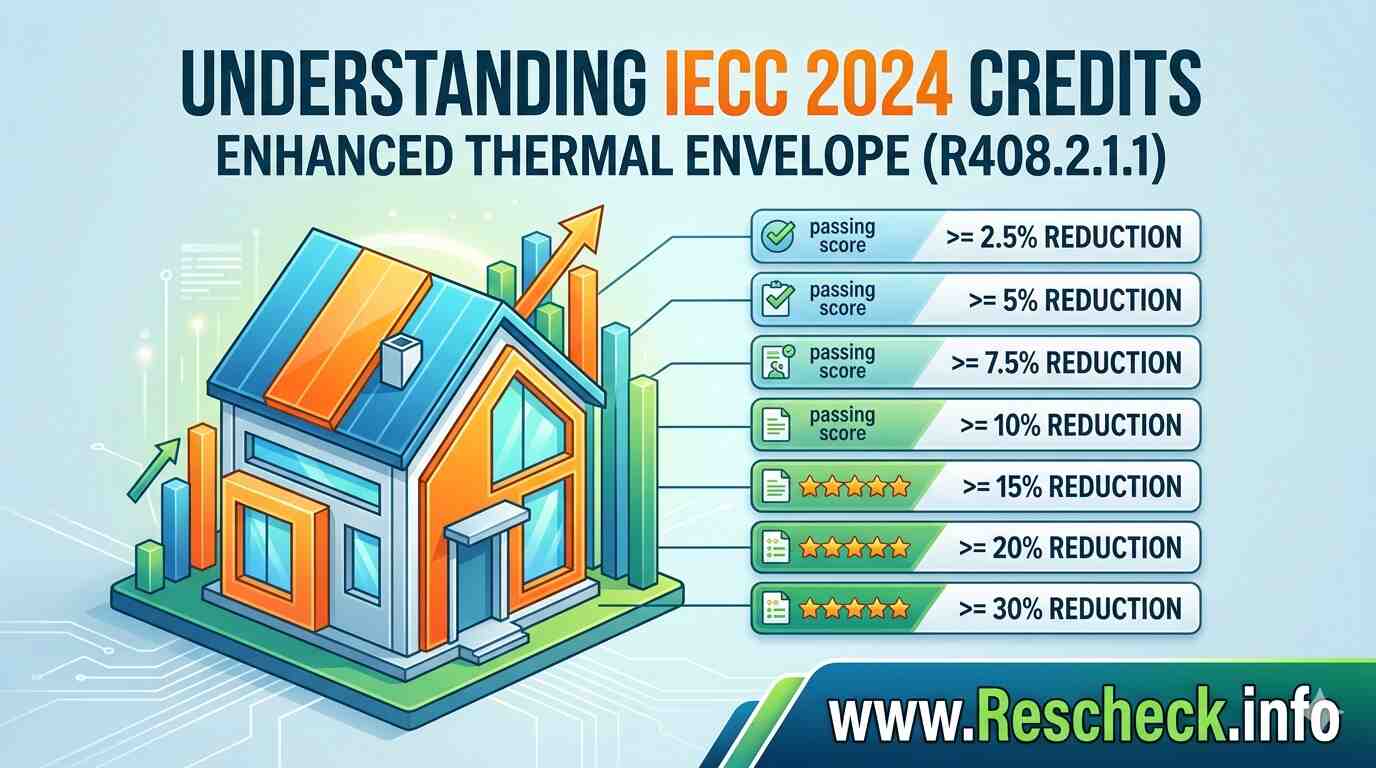
Credit Tiers: A breakdown of the seven credit levels, ranging from a 2.5% reduction (minor upgrades) to a 30% reduction (Zero Energy Ready standards).
High-Performance Strategies: Insights into using continuous insulation (ci), triple-pane windows, and advanced framing to hit higher credit thresholds.
Rescheck Implementation: Tips for inputting NFRC labels and monitoring "Proposed vs. Code UA" to ensure accurate reporting and successful building inspections.
IECC 2024 Credits: Understanding Enhanced Building Thermal Envelope Performance in Rescheck
About the Author: Jobe Leonard, IECC Compliance Expert

Jobe Leonard Rescheck.info
Jobe Leonard is the founder and lead consultant at Rescheck.info, where he specializes in professional Rescheck reporting and building energy code compliance. With years of experience in the energy sector, Jobe is an expert in navigating complex home energy audit software, including Rescheck, Comcheck, and Manual J Load Calculations.
Dedicated to helping builders, architects, and homeowners achieve energy efficiency, Jobe provides deep-dive insights into the latest IECC standards and technical tutorials for the building industry.
The release of the 2024 International Energy Conservation Code (IECC) introduces a more robust points-based system for achieving energy efficiency. For builders, designers, and energy auditors using Rescheck, one of the most critical sections to master is Section R408.2.1.1, which focuses on Enhanced Building Thermal Envelope Performance.
These credits reward projects that go above and beyond the baseline prescriptive requirements for the building shell. Here is a breakdown of how these credits work and what they mean for your next Rescheck report.
What is Total Thermal Conductance?
Before diving into the specific credits, it is important to understand Total Thermal Conductance. In the context of Rescheck, this refers to the UA (U-factor multiplied by Area) of the building.
To earn these credits, your building envelope—including walls, windows, ceilings, and floors—must perform better than a standard “code-minimum” home. The more you reduce the heat flow (conductance), the more credits you earn toward IECC 2024 compliance.
Breaking Down the R408.2.1.1 Credits
The IECC 2024 categorizes these credits based on the percentage of reduction in total thermal conductance compared to the baseline.
1. R408.2.1.1(1): ≥ 2.5% Reduction
This is the entry-level credit. Achieving a 2.5% reduction is often possible through minor upgrades, such as slightly better window U-factors or improved attic insulation. In Rescheck, this will show as a “Pass” margin slightly above the zero-threshold.
2. R408.2.1.1(2): ≥ 5% Reduction
A 5% reduction typically requires a more holistic approach. You might look at upgrading from R-20 to R-21 walls or ensuring that your rim joists are better insulated.
3. R408.2.1.1(3): ≥ 7.5% Reduction
At this level, you are moving into “high-performance” territory. Achieving a 7.5% reduction often involves a combination of high-efficiency glazing and superior ceiling insulation (e.g., moving from R-49 to R-60).
4. R408.2.1.1(4): ≥ 10% Reduction
A 10% reduction is a significant milestone. In many climate zones, this may require the use of continuous insulation (ci) on exterior walls to break thermal bridging, significantly lowering the overall UA of the project.
5. R408.2.1.1(5): ≥ 15% Reduction
To hit a 15% reduction, the building envelope must be exceptionally tight. This often requires “super-insulating” multiple components, such as R-30 floors over unconditioned spaces and triple-pane windows.
6. R408.2.1.1(6): ≥ 20% Reduction
A 20% reduction represents a top-tier energy-efficient home. This level of conductance reduction usually requires advanced framing techniques and high-performance continuous insulation across all exterior surfaces.
7. R408.2.1.1(7): ≥ 30% Reduction
The 30% reduction credit is the gold standard for thermal envelope performance. This is typically reserved for “Zero Energy Ready” homes or Passive House-inspired designs where the thermal shell is so efficient that heating and cooling loads are minimized to their absolute lowest levels.
How to Apply These in Rescheck
When you are performing a Rescheck Web or Desktop calculation under the IECC 2024:
Input Precise Values: Don’t rely on defaults. Use the specific U-factors from your window NFRC labels and the actual R-values of your insulation.
Monitor the UA Percentage: Rescheck compares your “Proposed UA” to the “Code UA.” The percentage by which your proposed UA is lower than the code UA determines which R408 credit you can claim.
Documentation: Ensure that the specifications used in your Rescheck match your blueprints. If you claim a 10% reduction credit, the building inspector will look for those specific insulation levels on-site.
Conclusion
The IECC 2024 Enhanced Building Thermal Envelope credits offer a flexible pathway for builders to meet energy goals. By focusing on reducing thermal conductance, you not only comply with the latest building codes but also provide homeowners with lower utility bills and increased comfort.
If you need assistance navigating the new IECC 2024 requirements or need a professional Rescheck report for your project, staying updated on these conductance reductions is the first step toward a successful build. Email your PDF plans, jobsite address, and square footage to service@rescheck.info to get started on a Rescheck today.