Summary
This blog post provides a technical breakdown of the IECC 2024 Section R408.2.2 cooling and heating credits. It simplifies complex energy codes by comparing five key HVAC compliance paths—ranging from ground source heat pumps to high-performance gas furnaces—and explains the "None" option's impact. Readers will learn how to choose the right equipment to earn the mandatory credits required for a passing Rescheck report.
Navigating the 2024 International Energy Conservation Code (IECC) can feel like decoding a secret language, especially with the new Section R408 credit system. If you’re using Rescheck to certify a new build, understanding these specific HVAC credits is the difference between a quick “Pass” and a redesign headache.
About the Author:

Jobe Leonard Rescheck.info
This guide was written by Jobe Leonard of Rescheck.info. Jobe is a dedicated expert in the field of home energy performance, with a passion for Rescheck reporting and the detailed study of home energy audit softwares including Rescheck, Comcheck, and Manual J.
In the 2024 IECC, prescriptive compliance now requires earning a minimum number of credits (usually 10 or more depending on your Climate Zone). Here is the breakdown of the Cooling & Heating credits under R408.2.2 and how they impact your project.
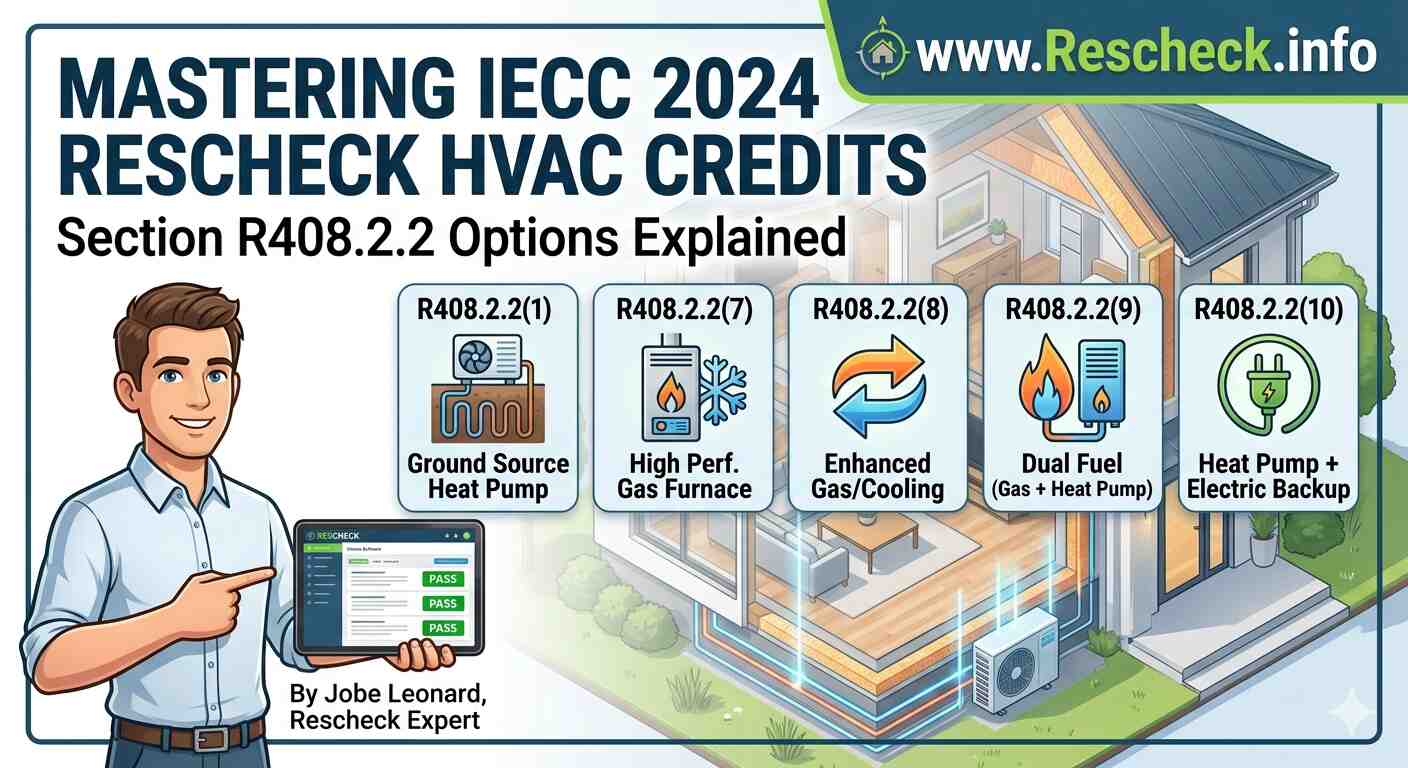
1. R408.2.2(1): Ground Source Heat Pump (GSHP)
This is often the “Gold Standard” for credits. Because ground source (geothermal) heat pumps use the stable temperature of the earth rather than volatile outside air, they are incredibly efficient.
The Tech: Systems typically require a COP (Coefficient of Performance) of 3.5+ and an EER of 16.1+.
The Credit: This usually provides the highest point value in the HVAC category. If you are struggling to hit your 10-point goal, a GSHP can often get you more than halfway there in one shot.
2. R408.2.2(7) & (8): High Performance Gas Furnace and Cooling
These options are for builders sticking with traditional natural gas or propane but pushing the limits of efficiency.
Option 1 (7): Typically requires a furnace with 95% AFUE or higher, paired with an A/C unit meeting SEER2 16 (or equivalent).
Option 2 (8): A “step up” in performance, usually requiring 96% or 97% AFUE and even higher SEER2/EER2 ratings for the cooling side.
Why the difference? Option 2 offers more credits than Option 1 but requires more expensive, top-tier equipment.
3. R408.2.2(9): High Performance Gas Furnace and Heat Pump (Dual Fuel)
Commonly known as a “Dual Fuel” or “Hybrid” system, this pairs a gas furnace for extreme cold with an electric heat pump for moderate temperatures.
The Benefit: You get the reliability of gas with the efficiency of a heat pump.
The Requirement: To earn this credit, both the furnace (usually 95% AFUE) and the heat pump (usually 15.2+ SEER2 / 7.8+ HSPF2) must meet high-efficiency thresholds.
4. R408.2.2(10): High Performance Heat Pump with Electric Resistance Backup
This is the “All-Electric” path. Unlike the dual-fuel option, this system uses an electric heat strip as the secondary heat source.
The Catch: Because electric resistance heat is less efficient than a heat pump, the primary unit must be high-performing (often requiring a Variable Capacity compressor) to ensure the backup rarely kicks in.
The Credit: This is a popular choice for “Net Zero” or “Electrification” focused builds and carries a competitive credit weight.
Summary Table: Which One Should You Choose?
| Credit Option | Best For… | Efficiency Focus |
| (1) Ground Source | High-budget, maximum efficiency | Geothermal Exchange |
| (7) Gas + Cooling (Opt 1) | Budget-friendly compliance | 95% AFUE / Standard SEER2 |
| (8) Gas + Cooling (Opt 2) | High-efficiency gas builds | 97% AFUE / High SEER2 |
| (9) Gas + Heat Pump | Cold climates / “Hybrid” lovers | Dual Fuel Versatility |
| (10) Heat Pump + Electric | All-electric / Solar-ready homes | Variable Speed Technology |
What if I select “None”?
Selecting “None” means you are not claiming any additional efficiency credits from the HVAC equipment. While this saves on equipment costs, it means you must find those 10 credits elsewhere—likely through expensive upgrades to your windows (U-factor), wall insulation (R-value), or ultra-low duct leakage testing.
Pro Tip for Rescheck
When entering these into your software, ensure your AHRI Certificate matches the requirements of the credit you’ve selected. If you claim credit (8) but install a 92% AFUE furnace, your Rescheck will be invalid upon inspection.
If you need a Rescheck created email pdf plans, jobsite address, and square footage to service@rescheck.info and we will get you taken care of.