Summary
The "Big Four" Distribution Credits
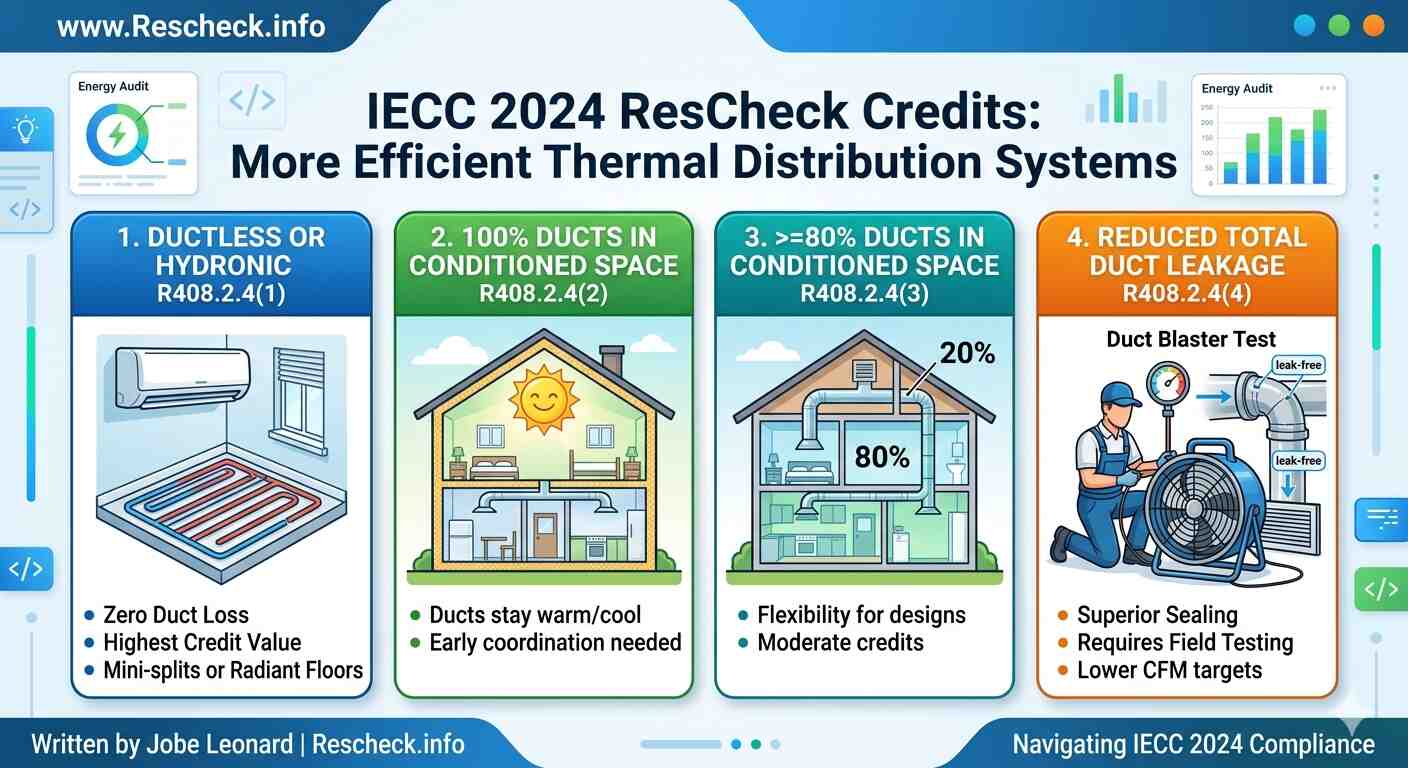
1. Ductless or Hydronic (The "Zero Loss" Option)
What it is: Using mini-splits or water-based radiant flooring instead of traditional air ducts.
The Benefit: Since there are no ducts, there is no chance for air to leak into the attic or crawlspace. This usually earns the most points.
2. 100% of Ducts Inside (The "Safe & Sound" Option)
What it is: Every inch of ductwork and the furnace/air handler is located inside the insulated part of the house.
The Benefit: If a duct leaks, the air stays inside your living space. This is highly efficient but requires careful architectural planning.
3. 80% of Ducts Inside (The "Middle Ground")
What it is: Most of your ducts (at least 80%) are inside the house, but a small portion is allowed to run through unconditioned areas like a garage or vented attic.
The Benefit: It’s more flexible than the 100% rule while still offering a significant energy credit for ResCheck.
4. Reduced Duct Leakage (The "Super Seal" Option)
What it is: You keep your ducts in the attic or crawlspace, but you seal them much tighter than the standard building code requires.
The Benefit: You must prove this with a "Duct Blaster" test. It’s the easiest option for traditional builds that don't want to change their floor plans.
Which one should you choose?
For Max Points: Go Ductless or 100% Inside.
For Minimal Design Changes: Go with Reduced Leakage.
For Difficult Layouts: Go with the 80% Rule.
Note: You can only pick one of these options to count toward your R408 credit requirements in ResCheck. Pick the one that best fits your budget and framing style.
Master the IECC 2024 ResCheck: Thermal Distribution Credits Explained
About the Author

Jobe Leonard Rescheck.info
Jobe Leonard is the founder of Rescheck.info and a leading expert in energy compliance. With a passion for high-performance building science, Jobe specializes in the nuances of Rescheck reporting and the evolving landscape of energy audit software. Whether it’s mastering Rescheck, Comcheck, or Manual J calculations, he is dedicated to helping builders and designers navigate the complexities of modern energy codes.
Navigating the 2024 International Energy Conservation Code (IECC) can feel like a maze, especially with the updated “Credit” system. To achieve compliance via the prescriptive path, builders must now earn a specific number of points from the R408 Additional Efficiency Options.
One of the most impactful ways to earn these points is through Section R408.2.4: More Efficient Thermal Distribution Systems. Since heating and cooling account for the largest energy drain in a home, the IECC rewards you for keeping that conditioned air where it belongs.
Here is a breakdown of the four primary thermal distribution credits and how to choose the right one for your ResCheck.
1. Ductless or Hydronic Systems | R408.2.4(1)
This is the “gold standard” for distribution efficiency. This credit applies to homes that eliminate traditional ducted forced-air systems entirely.
-
How it works: You qualify by using ductless mini-splits or hydronic (hot water) radiant flooring/baseboards.
-
The Logic: Without ducts, there is zero “duct loss”—no air leaking into attics or crawlspaces and no energy lost through duct walls.
-
Why choose this: It typically offers the highest point value in ResCheck because it removes the most common failure point in home energy envelopes.
2. 100% of Ducts in Conditioned Space | R408.2.4(2)
If you are sticking with a ducted furnace or heat pump, the best way to gain credits is to bring the entire system inside the “thermal envelope.”
-
The Requirement: All ducts and air handlers must be located within the insulated boundaries of the home (e.g., in a dropped ceiling, a conditioned crawlspace, or between floors).
-
The Benefit: Any “leaks” from the ducts actually stay inside the house, meaning the energy isn’t wasted.
-
Pro Tip: This requires early coordination with your HVAC designer and framers to ensure there is physical room for the trunk lines inside the living space.
3. >=80% of Ductwork in Conditioned Space | R408.2.4(3)
The IECC 2024 recognizes that 100% interior placement isn’t always possible due to architectural constraints or slab-on-grade designs.
-
The Requirement: At least 80% of the total linear footage of the ductwork must be located within the conditioned space.
-
The Compromise: This allows for small runs to reach difficult areas via a vented attic or crawlspace while still maintaining high overall efficiency.
-
ResCheck Impact: This earns fewer points than the 100% option but is significantly easier to achieve in traditional North American home designs.
4. Reduced Total Duct Leakage | R408.2.4(4)
If you can’t bring the ducts inside, you have to make them airtight. This credit focuses on superior installation quality rather than location.
-
The Requirement: You must demonstrate via a Duct Blaster Test that the leakage is significantly lower than the standard code minimum.
-
The Metric: While standard code might allow 4.0 cfm per 100 sq. ft. of conditioned floor area, this credit requires hitting much tighter targets (often 2.0 or 3.0 cfm depending on local jurisdiction amendments).
-
Why choose this: It’s a cost-effective way to get credits through better craftsmanship (mastic and tape) rather than expensive architectural changes.
Comparison Table: Thermal Distribution Credits
| Credit Option | Best For… | Difficulty | Efficiency Impact |
| Ductless/Hydronic | Modern builds / Additions | Medium | Highest |
| 100% Inside | New construction with open web joists | High | Very High |
| 80% Inside | Retrofits or complex layouts | Medium | High |
| Reduced Leakage | Traditional builds with attic HVAC | Low | Moderate |
How to Apply These to Your ResCheck
When running your ResCheck software, you will find these options under the “Requirements” or “Additional Efficiency Packages” tab.
Important: You cannot “double dip” on some of these. For instance, if you choose “Ductless,” you cannot also claim “Reduced Leakage” because there are no ducts to leak! Always verify with your local building official which version of the 2024 IECC they have adopted, as point values can fluctuate by climate zone.
Ready to simplify your compliance?
Thermal distribution is just one piece of the IECC 2024 puzzle. By focusing on keeping your air inside the conditioned envelope, you not only pass inspection faster but also deliver a more comfortable, lower-utility-cost home to your clients.
If you need a Rescheck email pdf plans, jobsite address, and square footage to service@rescheck.info and we will get you taken care of.