Summary
This article provides a comprehensive guide to understanding and applying Roof Solar Reflectance Index (SRI) credits under the 2024 IECC for Rescheck compliance. It breaks down how builders can earn mandatory efficiency credits by selecting roofing materials that mitigate heat gain.
Key Highlights:
Definition of SRI: Explains how the Solar Reflectance Index measures a roof's ability to reject solar heat and radiate absorbed energy.
Credit Pathways (Section R408.2.1.3):
Option 1: Credits for roofs directly over conditioned spaces (e.g., vaulted ceilings), reducing direct cooling loads.
Option 2: Credits for roofs over unconditioned attics containing ducts, preventing "duct baking" and improving HVAC efficiency.
The "None" Selection: Clarifies that skipping these credits requires making up energy points through other mechanical or envelope upgrades.
Builder Benefits: Highlights secondary advantages like reduced HVAC tonnage, increased roof longevity, and improved indoor comfort.
Verification: Instructions on using CRRC (Cool Roof Rating Council) labels to provide the necessary data for Rescheck software.
The Goal: To help construction professionals leverage "cool roof" technology to meet 2024 energy codes without relying solely on expensive equipment upgrades.
Navigating the 2024 International Energy Conservation Code (IECC) can feel like a maze, especially with the newer “Additional Efficiency Package Options” required for a passing ResCheck. One of the most effective ways to earn these mandatory credits is by optimizing your roof’s Solar Reflectance Index (SRI).
About the Author: Jobe Leonard

Jobe Leonard Rescheck.info
Jobe Leonard is the founder of Rescheck.info and a leading expert in residential energy compliance. With a passion for sustainable building science, Jobe specializes in Rescheck reporting and the deep-dive study of home energy audit software.
Whether he is navigating the complexities of Comcheck for commercial projects or performing precise Manual J load calculations for HVAC sizing, Jobe is dedicated to helping builders and homeowners optimize energy efficiency. His technical expertise ensures that every project meets the rigorous standards of modern energy codes while streamlining the building permit process.
Under Section R408.2.1.3, the IECC offers two distinct pathways to gain credits based on how your roof handles solar heat gain. Here is a breakdown of how these credits work and how to apply them to your next project.
What is the Solar Reflectance Index (SRI)?
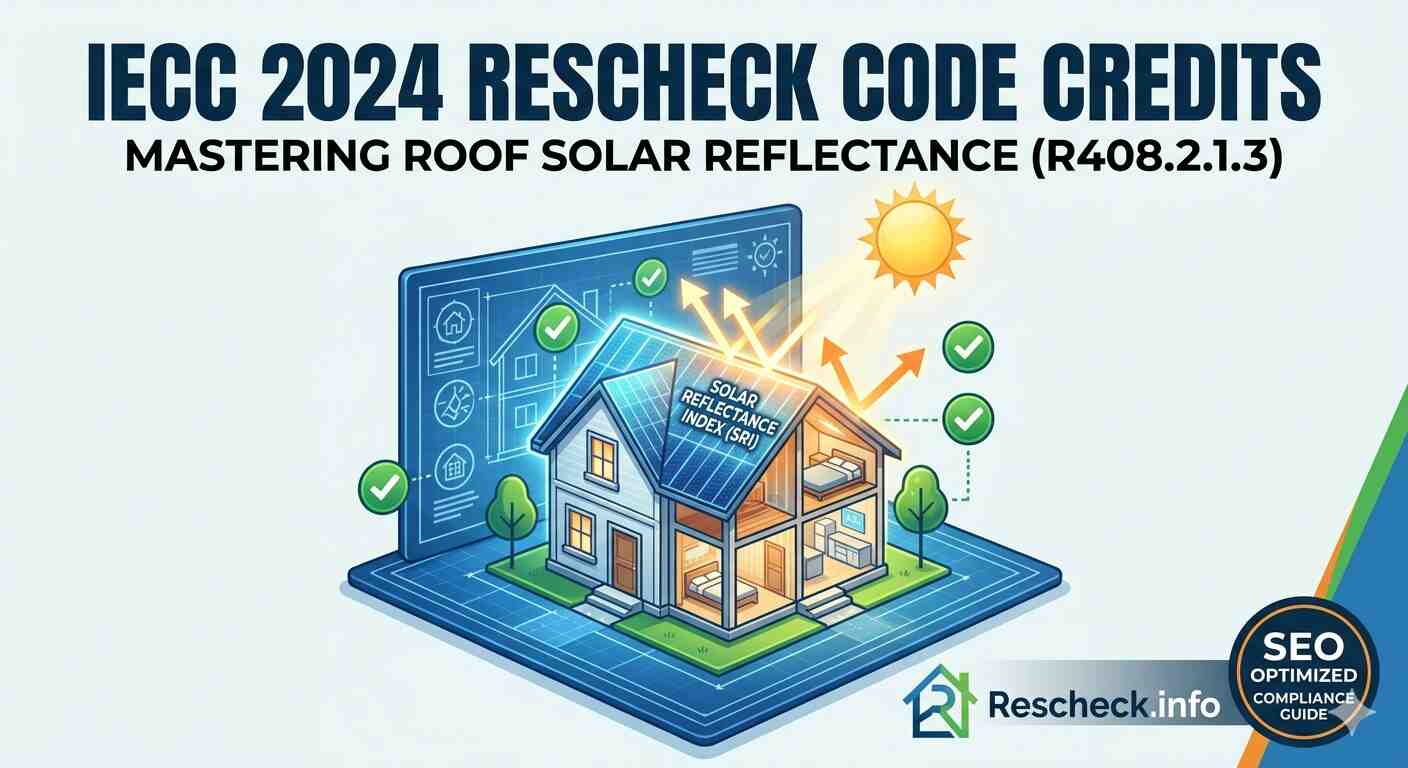
SRI is a measure of a roof’s ability to reject solar heat, combined with its ability to emit thermal radiation.
-
High SRI: Reflects more sunlight and stays cooler (think “Cool Roofs”).
-
Low SRI: Absorbs more heat, increasing the cooling load on the building.
Understanding the Two Credit Categories
The IECC 2024 distinguishes between roofs directly over living spaces and those over attics containing mechanical systems.
1. R408.2.1.3(1): Roof Over Conditioned Space
This credit applies when the roof is part of the building thermal envelope and is located directly above a cooled, conditioned space.
-
The Logic: By reflecting heat away from the ceiling of a living area, you directly reduce the energy required by the AC unit to keep that room comfortable.
-
Applicability: Best for vaulted ceilings, “hot roofs” (conditioned attics), or flat roof assemblies where there is no vented attic space.
2. R408.2.1.3(2): Roof Over Unconditioned Space with Ducts
This credit is specific to roofs located above an unconditioned space (like a standard vented attic) that houses a duct system.
-
The Logic: Even if the attic isn’t “lived in,” a hot attic cooks the air inside your ductwork. A high SRI roof keeps the attic cooler, ensuring the air coming out of your vents stays at the desired temperature without the HVAC system working overtime.
-
The Benefit: This is often an easier “win” for traditional suburban builds where HVAC equipment is tucked away in the attic.
Why Choose “None”?
In ResCheck, selecting “None” simply means you are not pursuing this specific efficiency credit.
Note: If you select “None,” you must make up those efficiency points elsewhere—such as through higher-efficiency HVAC equipment (R408.2.2) or improved water heating (R408.2.3).
Strategic Advantages for Builders
Choosing a high SRI roof isn’t just about code compliance; it offers several market advantages:
| Feature | Benefit |
| Reduced Tonnage | Cooler attics can sometimes allow for smaller (and cheaper) HVAC units. |
| Longevity | Reduced thermal expansion and contraction can extend the life of roofing materials. |
| Occupant Comfort | Less radiant heat transfer leads to more consistent indoor temperatures. |
How to Verify for ResCheck
To claim these credits, you must ensure the roofing material (shingles, metal, or tile) is tested and labeled. Look for the CRRC (Cool Roof Rating Council) label on the product data sheet. You will need to input the specific initial or aged solar reflectance and thermal emittance values into your ResCheck software to satisfy the R408.2.1.3 requirements.
Final Thoughts
The 2024 IECC update pushes residential construction toward a more “passive” approach to cooling. By utilizing Section R408.2.1.3, you can leverage the roof—one of the largest surface areas of the home—to meet your energy goals without necessarily upgrading expensive mechanical hardware.
If you need a Rescheck you can email pdf plans, jobsite address, and square footage to service@rescheck.info