Summary
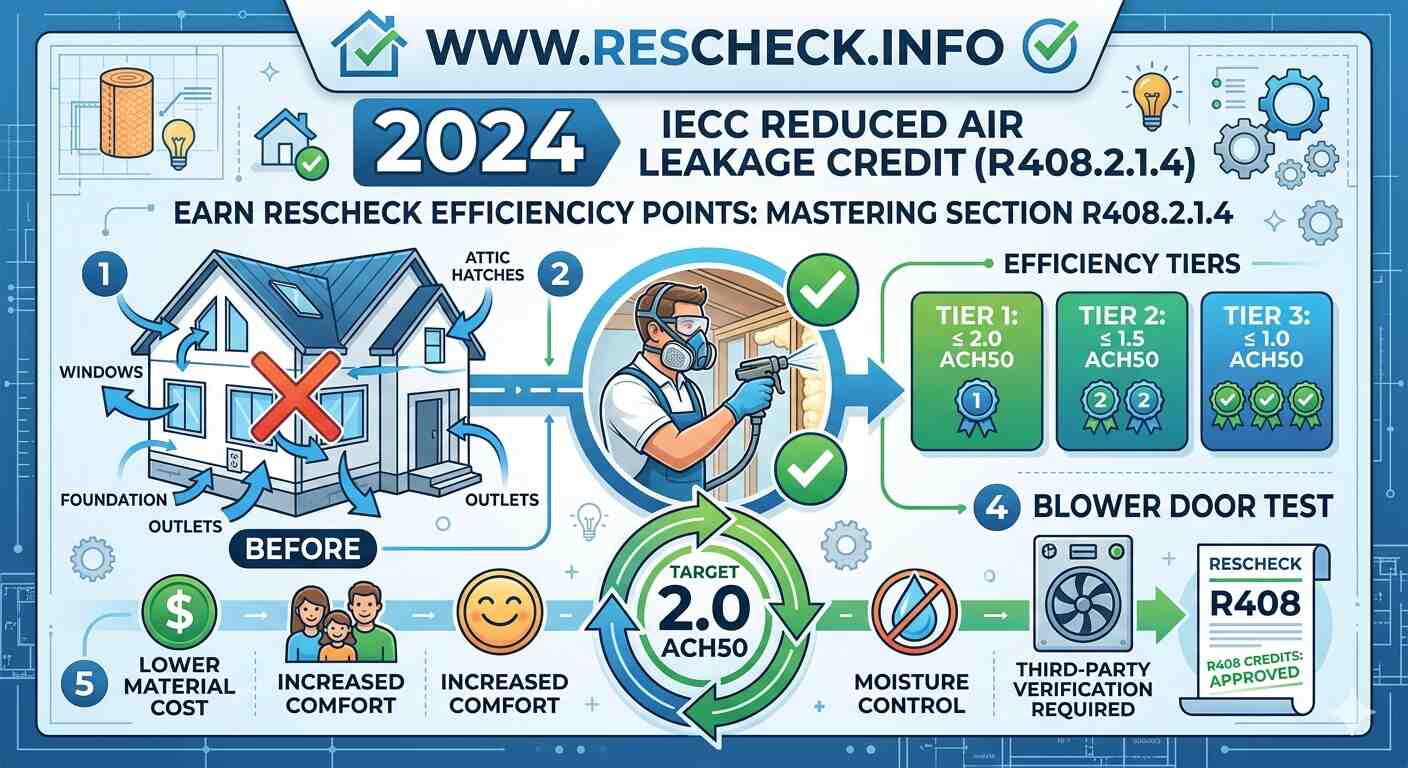
At a Glance: The R408.2.1.4 Credit (2024 IECC)The 2024 IECC requires builders to earn "Efficiency Credits" to pass inspection. One of the most common ways to get these points is by reducing home air leakage (drafts) beyond the standard legal limit.1. What is it?It’s a performance-based credit. Instead of just meeting the basic airtightness rules, you commit to building a "super-tight" house. You earn points in Rescheck based on how low your ACH50 (Air Changes per Hour) score is.2. The Goal TiersThe tighter the house, the more credits you earn:Good: $le 2.0$ ACH50Better: $le 1.5$ ACH50Best: $le 1.0$ ACH503. Why Builders Love This CreditCost-Effective: It’s often cheaper to spend a few extra hours on caulk and foam than to buy expensive high-tech windows or thicker insulation.Better Quality: It prevents drafts and moisture damage, which means fewer "callback" complaints from homeowners.4. How to Verify ItYou can't just "pinky promise" this one. To officially claim the credit on your Rescheck, a third-party professional must perform a Blower Door Test once the house is finished to prove you hit your target number.The Golden Rule: If you go below 3.0 ACH50, you must install mechanical ventilation (like an ERV or HRV) to ensure the house has fresh air to breathe!
If you are navigating the new 2024 International Energy Conservation Code (IECC), you’ve likely noticed that simply meeting the minimum requirements isn’t enough anymore. To achieve compliance via the Prescriptive Path, builders must now earn additional “efficiency credits” from Section R408.
This article was written by Jobe Leonard, the founder and lead consultant at Rescheck.info. A recognized expert in the field of residential energy compliance, Jobe specializes in high-accuracy Rescheck reporting and the technical analysis of home energy audit software.

Jobe Leonard Rescheck.info
With years of experience navigating complex building codes, Jobe Leonard is dedicated to helping builders and architects master tools like Rescheck, Comcheck, and Manual J to ensure energy-efficient design and seamless permit approval.
One of the most effective ways to secure these points is through Section R408.2.1.4: Reduced Air Leakage. Here is everything you need to know to leverage this credit in your next Rescheck.
What is the Reduced Air Leakage Credit?
In previous code cycles, air leakage (infiltration) was a binary “pass/fail” metric—usually capped at 3.0 or 5.0 Air Changes per Hour (ACH50). In the 2024 IECC, if you go beyond the mandatory baseline, you can earn credits toward your total compliance score.
Section R408.2.1.4 rewards builders who tighten the building envelope significantly more than the standard code requires.
The Thresholds for Credits
To claim points under this section, the building must be tested and verified to meet specific ACH50 levels that are lower than the standard requirements for your Climate Zone.
| Metric | Target Requirement |
| Baseline Requirement | Usually 3.0 ACH50 (Climate Zones 3–8) |
| Credit Target 1 | $\le 2.0$ ACH50 |
| Credit Target 2 | $\le 1.5$ ACH50 |
| Credit Target 3 | $\le 1.0$ ACH50 |
Note: The tighter the home, the more credits you earn. However, ultra-tight homes ($\le 3.0$ ACH50) require mechanical ventilation according to Section R403.6 to ensure indoor air quality.
Why Choose This Credit for Your Rescheck?
Using Reduced Air Leakage as your R408 credit choice is a “bang for your buck” strategy for several reasons:
-
Lower Material Costs: Unlike adding expensive triple-pane windows or high-R exterior foam, air sealing often relies on labor and inexpensive materials (caulk, spray foam, gaskets).
-
Increased Comfort: A tighter envelope eliminates drafts and cold spots, leading to higher homeowner satisfaction.
-
Moisture Control: Proper air sealing prevents humid air from migrating into wall cavities, reducing the risk of mold and structural rot.
How to Document R408.2.1.4 in Rescheck
When you are performing your Rescheck Web or Desktop analysis, you will find a section for “Additional Efficiency Packages.” To claim the R408.2.1.4 credit, you must:
-
Select the Credit: Check the box for “Reduced Air Leakage.”
-
Specify the Target: Enter the ACH50 value you intend to hit.
-
Verification: Remember, this is a performance-based credit. You cannot just “claim” it; a certified third-party (BPI or RESNET rater) must perform a Blower Door Test at the end of construction to verify the house actually hits the target number.
Pro-Tips for Hitting < 2.0 ACH50
If you are aiming for the higher credit tiers (1.5 or 1.0 ACH50), standard “poly-seal” isn’t enough. Consider these strategies:
-
The “AeroBarrier” Approach: Using aerosolized sealant can automatically find and plug leaks you can’t see.
-
Gasketed Drywall: Use foam gaskets on the top plates of interior and exterior walls before the drywall is hung.
-
Rim Joist Discipline: Spray foam the rim joists—this is historically the leakiest part of a home.
-
Hub-and-Spoke Sealing: Pay special attention to penetrations for plumbing, electrical, and HVAC that cross the thermal boundary.
Final Thoughts
The 2024 IECC is pushing the industry toward high-performance building envelopes. Section R408.2.1.4 is a win-win: it helps you pass your Rescheck with flying colors while delivering a superior, energy-efficient product to the homeowner.
Are you struggling to get your Rescheck to pass under the 2024 IECC? Focus on your air leakage—it’s often the path of least resistance to compliance!
If you need a Rescheck completed email pdf plans, jobsite address, and square footage to service@rescheck.info and we will get you taken care of.