
Summary

This post provides a technical yet accessible breakdown of the Section R408 credit options within the 2024 IECC Rescheck software, specifically focusing on cooling efficiency. It is designed to help builders and consultants choose the most cost-effective path to energy code compliance.

Key Highlights
The R408 Framework: Explains the transition from prescriptive minimums to the "additional efficiency package" requirements in the 2024 code.

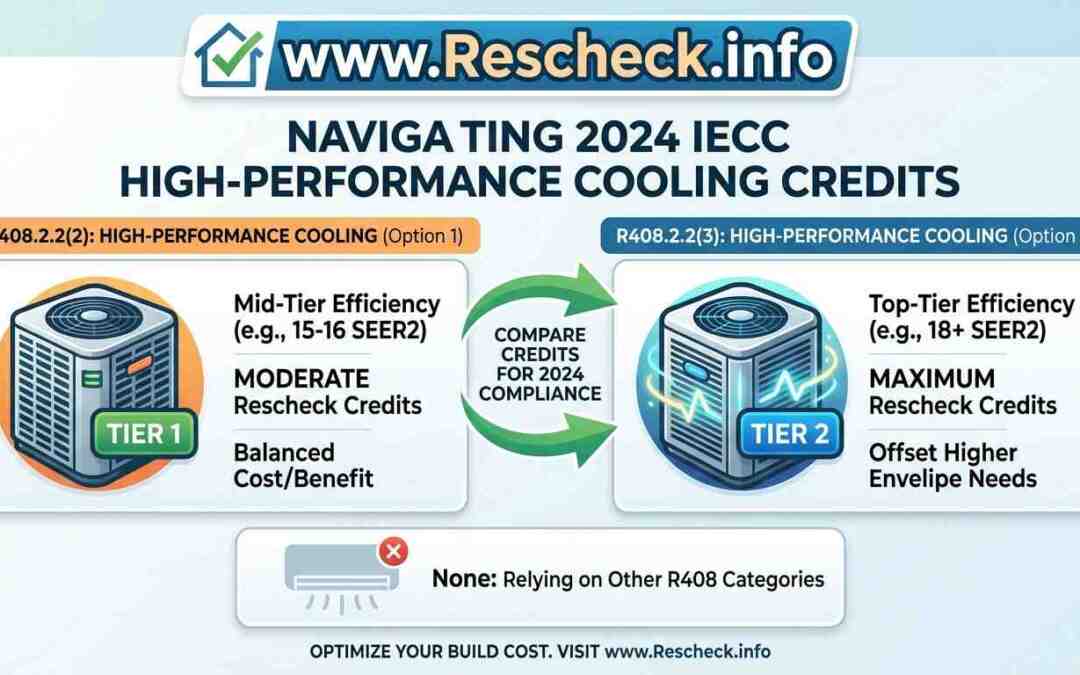
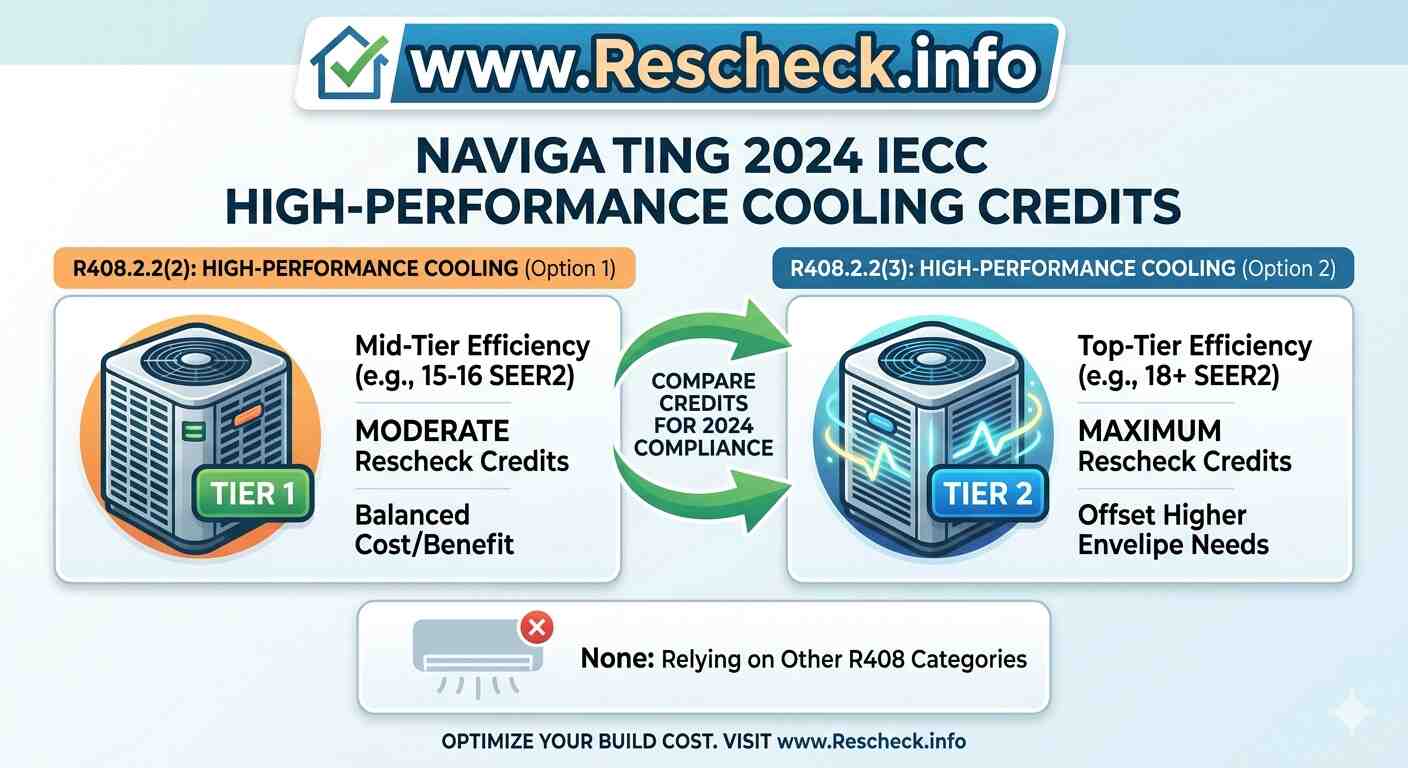
Option 1 vs. Option 2: * R408.2.2(2): Mid-tier efficiency (e.g., 15–16 SEER2) for moderate credit gains.

R408.2.2(3): High-tier efficiency (e.g., 18+ SEER2) for maximum credit gains, ideal for projects with high glazing ratios.

Strategic Compliance: Discusses why selecting "None" may be more expensive in the long run compared to modest HVAC upgrades.

Actionable Workflow: A three-step process for using Rescheck to toggle between cooling options to find the lowest construction cost for a passing score.

Target Audience
Residential Building Contractors

HVAC Professionals

Energy Auditors & Consultants

Architects specializing in building code compliance

Unlocking IECC 2024 Credits: A Guide to High-Performance Cooling in Rescheck

About the Author: Jobe Leonard, Rescheck Expert (Reschexpert)

Jobe Leonard Rescheck.info

Jobe Leonard Rescheck.info

Jobe Leonard is the founder of Rescheck.info and a leading consultant in the home energy sector. With a deep focus on Rescheck reporting, he specializes in the technical analysis of energy audit software, including Rescheck, Comcheck, and Manual J load calculations. As a professional energy analyst, Jobe is dedicated to helping builders and homeowners navigate building code compliance through precise energy modeling and conservation strategies.

As the building industry transitions to the 2024 International Energy Conservation Code (IECC), developers and energy consultants are seeing a shift in how “credits” are earned. One of the most significant opportunities for compliance flexibility lies in Section R408, which requires additional efficiency packages beyond the standard prescriptive requirements.

If you are using Rescheck to demonstrate compliance, understanding the distinction between High-Performance Cooling Option 1 and Option 2 is critical for hitting your energy targets without overspending on materials.


What is Section R408?

In the 2024 IECC, simply meeting the minimum R-values for walls and ceilings often isn’t enough. Section R408 requires builders to select additional efficiency “options” to earn credits. Cooling efficiency is one of the most cost-effective ways to bridge the gap if your building envelope is struggling to pass.

R408.2.2(2): High-Performance Cooling (Option 1)

Option 1 is designed for projects that want a significant boost in efficiency without necessarily moving into “ultra-premium” equipment territory.

  • The Requirement: This credit generally requires cooling equipment that exceeds federal minimum standards by a specific percentage (often aligning with higher SEER2 ratings).

  • The Benefit: By selecting this in Rescheck, you earn a moderate amount of credits toward your R408 total. It is an excellent middle-ground for suburban residential builds.

  • Best For: Builders already planning to use 15–16 SEER2 systems who need a small “push” to make their Rescheck pass.

R408.2.2(3): High-Performance Cooling (Option 2)

Option 2 is the “Tier 2” of cooling credits. It offers a higher credit value but carries more stringent equipment requirements.

  • The Requirement: This typically mandates top-of-the-line HVAC systems. We are looking at high-efficiency heat pumps or air conditioners, often requiring SEER2 ratings in the 18+ range or specialized variable-speed compressors.

  • The Benefit: This option provides the maximum number of credits available in the cooling category. If your glass-to-wall ratio is high or your insulation is at the bare minimum, Option 2 can often save the entire project’s compliance status.

  • Best For: Custom homes with large window packages or “Zero Energy Ready” builds.


The “None” Option: Why It Matters

In Rescheck, you will see the option for “None.” Selecting this means you are relying entirely on other categories—such as R408.2.1 (Enhanced Envelope) or R408.2.5 (High-Efficiency Service Water Heating)—to meet your credit quota.

While “None” is the default, it is rarely the most economical choice. Because HVAC technology has improved so rapidly, the cost jump to meet Option 1 is often lower than the cost of adding extra inches of spray foam or upgrading to triple-pane windows.


How to Optimize Your Rescheck in 2024

When performing an energy audit or a Rescheck analysis under the 2024 IECC, follow these three steps:

  1. Check the Baseline: Run your Rescheck with standard equipment first.

  2. Toggle Option 1: If you are failing by a small margin, switch to R408.2.2(2). Check with your HVAC contractor to see the price difference for the required SEER2 rating.

  3. Evaluate Option 2: If you are significantly below the compliance threshold, R408.2.2(3) might be cheaper than upgrading your entire insulation package.

Conclusion

The 2024 IECC R408 credits turn energy compliance into a strategic “pick-and-choose” process. By understanding the tiers of High-Performance Cooling, you can provide better comfort for homeowners while keeping construction costs manageable.

Need help with your 2024 IECC Rescheck? Ensuring your cooling credits are calculated correctly is the key to a fast permit approval.  Email pdf plans, jobsite address, and square footage to service@rescheck.info and we will get you taken care of.
Summary
As the building industry transitions to the 2024 International Energy Conservation Code (IECC), developers and energy consultants are seeing a shift in how "credits" are earned. One of the most significant opportunities for compliance flexibility lies in Section R408, which requires additional efficiency packages beyond the standard prescriptive requirements. If you are using Rescheck to demonstrate compliance, understanding the distinction between High-Performance Cooling Option 1 and Option 2 is critical for hitting your energy targets without overspending on materials. What is Section R408? In the 2024 IECC, simply meeting the minimum R-values for walls and ceilings often isn't enough. Section R408 requires builders to select additional efficiency "options" to earn credits. Cooling efficiency is one of the most cost-effective ways to bridge the gap if your building envelope is struggling to pass. R408.2.2(2): High-Performance Cooling (Option 1) Option 1 is designed for projects that want a significant boost in efficiency without necessarily moving into "ultra-premium" equipment territory. The Requirement: This credit generally requires cooling equipment that exceeds federal minimum standards by a specific percentage (often aligning with higher SEER2 ratings). The Benefit: By selecting this in Rescheck, you earn a moderate amount of credits toward your R408 total. It is an excellent middle-ground for suburban residential builds. Best For: Builders already planning to use 15–16 SEER2 systems who need a small "push" to make their Rescheck pass. R408.2.2(3): High-Performance Cooling (Option 2) Option 2 is the "Tier 2" of cooling credits. It offers a higher credit value but carries more stringent equipment requirements. The Requirement: This typically mandates top-of-the-line HVAC systems. We are looking at high-efficiency heat pumps or air conditioners, often requiring SEER2 ratings in the 18+ range or specialized variable-speed compressors. The Benefit: This option provides the maximum number of credits available in the cooling category. If your glass-to-wall ratio is high or your insulation is at the bare minimum, Option 2 can often save the entire project's compliance status. Best For: Custom homes with large window packages or "Zero Energy Ready" builds. The "None" Option: Why It Matters In Rescheck, you will see the option for "None." Selecting this means you are relying entirely on other categories—such as R408.2.1 (Enhanced Envelope) or R408.2.5 (High-Efficiency Service Water Heating)—to meet your credit quota. While "None" is the default, it is rarely the most economical choice. Because HVAC technology has improved so rapidly, the cost jump to meet Option 1 is often lower than the cost of adding extra inches of spray foam or upgrading to triple-pane windows. How to Optimize Your Rescheck in 2024 When performing an energy audit or a Rescheck analysis under the 2024 IECC, follow these three steps: Check the Baseline: Run your Rescheck with standard equipment first. Toggle Option 1: If you are failing by a small margin, switch to R408.2.2(2). Check with your HVAC contractor to see the price difference for the required SEER2 rating. Evaluate Option 2: If you are significantly below the compliance threshold, R408.2.2(3) might be cheaper than upgrading your entire insulation package. Conclusion The 2024 IECC R408 credits turn energy compliance into a strategic "pick-and-choose" process. By understanding the tiers of High-Performance Cooling, you can provide better comfort for homeowners while keeping construction costs manageable. Need help with your 2024 IECC Rescheck? Whether you're building in Tennessee or across the country, ensuring your cooling credits are calculated correctly is the key to a fast permit approval.
Article Name
As the building industry transitions to the 2024 International Energy Conservation Code (IECC), developers and energy consultants are seeing a shift in how "credits" are earned. One of the most significant opportunities for compliance flexibility lies in Section R408, which requires additional efficiency packages beyond the standard prescriptive requirements. If you are using Rescheck to demonstrate compliance, understanding the distinction between High-Performance Cooling Option 1 and Option 2 is critical for hitting your energy targets without overspending on materials. What is Section R408? In the 2024 IECC, simply meeting the minimum R-values for walls and ceilings often isn't enough. Section R408 requires builders to select additional efficiency "options" to earn credits. Cooling efficiency is one of the most cost-effective ways to bridge the gap if your building envelope is struggling to pass. R408.2.2(2): High-Performance Cooling (Option 1) Option 1 is designed for projects that want a significant boost in efficiency without necessarily moving into "ultra-premium" equipment territory. The Requirement: This credit generally requires cooling equipment that exceeds federal minimum standards by a specific percentage (often aligning with higher SEER2 ratings). The Benefit: By selecting this in Rescheck, you earn a moderate amount of credits toward your R408 total. It is an excellent middle-ground for suburban residential builds. Best For: Builders already planning to use 15–16 SEER2 systems who need a small "push" to make their Rescheck pass. R408.2.2(3): High-Performance Cooling (Option 2) Option 2 is the "Tier 2" of cooling credits. It offers a higher credit value but carries more stringent equipment requirements. The Requirement: This typically mandates top-of-the-line HVAC systems. We are looking at high-efficiency heat pumps or air conditioners, often requiring SEER2 ratings in the 18+ range or specialized variable-speed compressors. The Benefit: This option provides the maximum number of credits available in the cooling category. If your glass-to-wall ratio is high or your insulation is at the bare minimum, Option 2 can often save the entire project's compliance status. Best For: Custom homes with large window packages or "Zero Energy Ready" builds. The "None" Option: Why It Matters In Rescheck, you will see the option for "None." Selecting this means you are relying entirely on other categories—such as R408.2.1 (Enhanced Envelope) or R408.2.5 (High-Efficiency Service Water Heating)—to meet your credit quota. While "None" is the default, it is rarely the most economical choice. Because HVAC technology has improved so rapidly, the cost jump to meet Option 1 is often lower than the cost of adding extra inches of spray foam or upgrading to triple-pane windows. How to Optimize Your Rescheck in 2024 When performing an energy audit or a Rescheck analysis under the 2024 IECC, follow these three steps: Check the Baseline: Run your Rescheck with standard equipment first. Toggle Option 1: If you are failing by a small margin, switch to R408.2.2(2). Check with your HVAC contractor to see the price difference for the required SEER2 rating. Evaluate Option 2: If you are significantly below the compliance threshold, R408.2.2(3) might be cheaper than upgrading your entire insulation package. Conclusion The 2024 IECC R408 credits turn energy compliance into a strategic "pick-and-choose" process. By understanding the tiers of High-Performance Cooling, you can provide better comfort for homeowners while keeping construction costs manageable. Need help with your 2024 IECC Rescheck? Whether you're building in Tennessee or across the country, ensuring your cooling credits are calculated correctly is the key to a fast permit approval.
Description
Master the 2024 IECC with this guide to Rescheck R408 cooling credits. Compare High-Performance Options 1 and 2 to find the most cost-effective path to energy code compliance for your project.
Author
Publisher Name
Rescheck.info
Publisher Logo