Summary
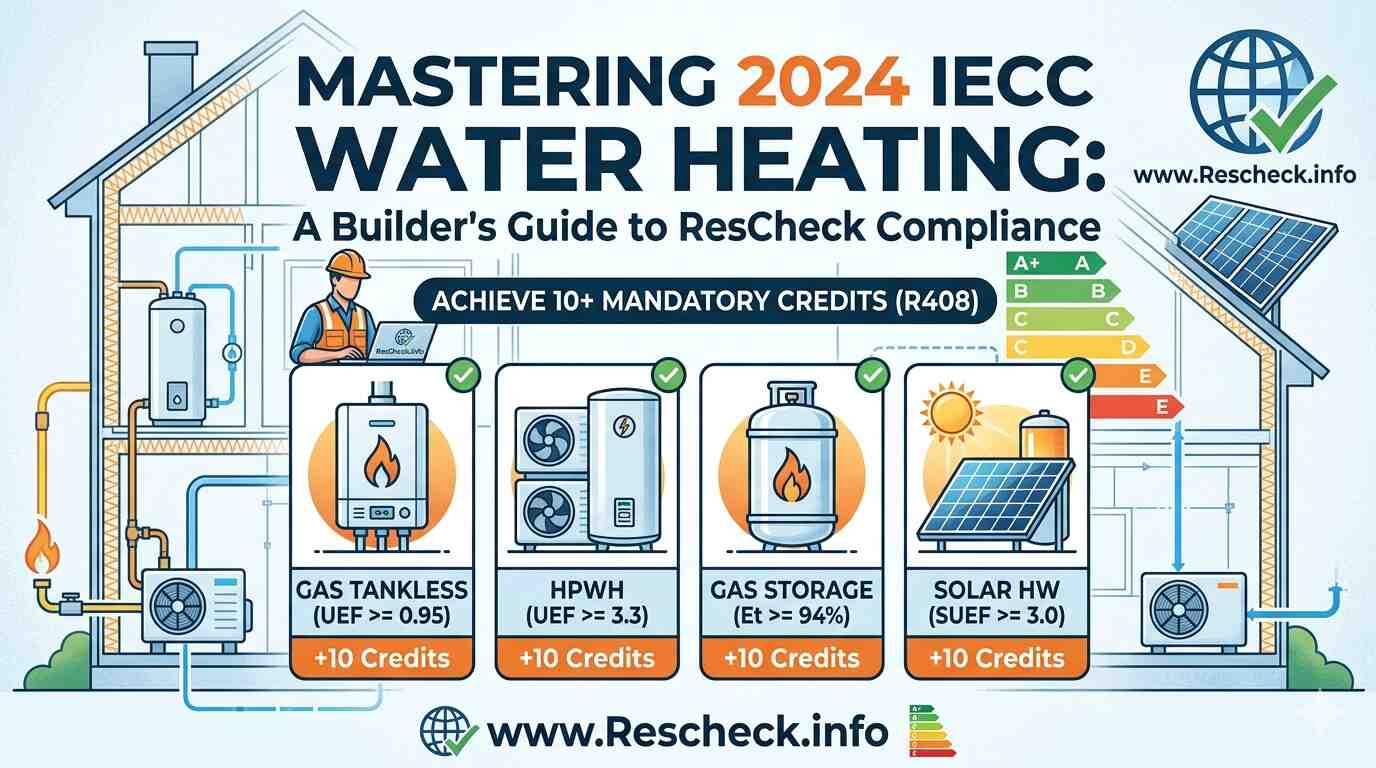
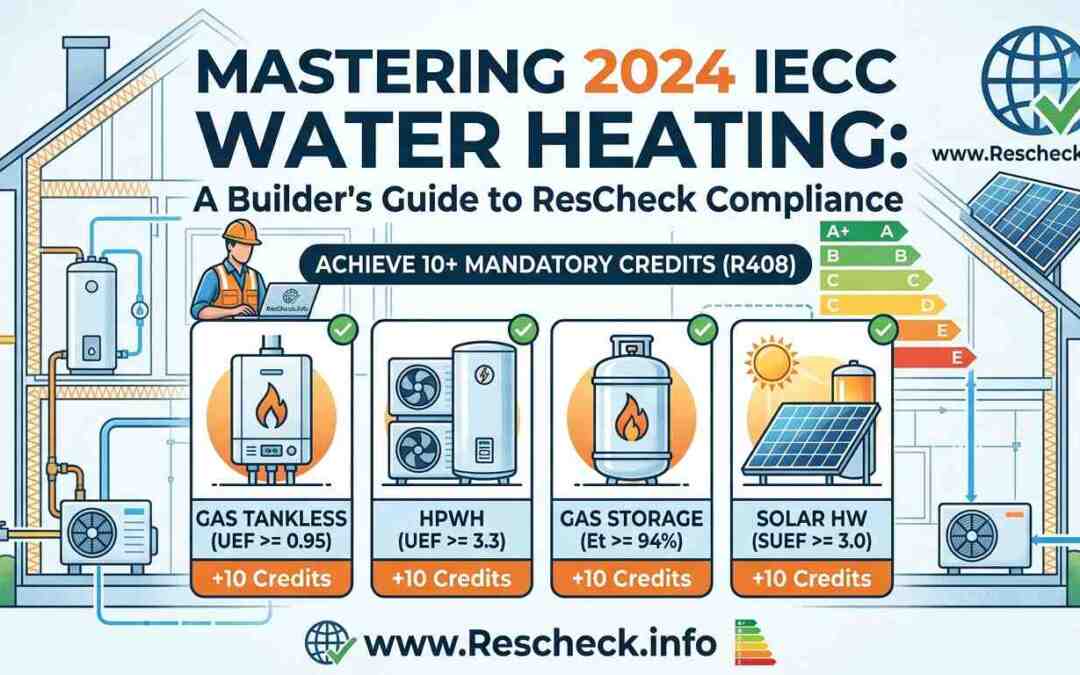
This blog post provides a comprehensive breakdown of the 2024 IECC (International Energy Conservation Code) additional efficiency requirements for residential water heating. It explains the specific UEF (Uniform Energy Factor) and COP (Coefficient of Performance) ratings required for gas-fired, electric heat pump, and solar water heaters to earn compliance credits in ResCheck.
Key Highlights:
Compliance Strategy: Explains how Section R408 requires builders to earn at least 10 credits (or 15 for large homes) from a menu of efficiency options.
Detailed Specs: Translates complex code sections—like R408.2.3(1) through (7)—into plain English for gas, electric, and solar systems.
Heat Pump Focus: Highlights the shift toward Heat Pump Water Heaters (HPWH) as a primary path for high-credit accumulation.
The "None" Option: Advises on the consequences of not selecting a water heating credit and how to compensate for it in other building envelope areas.
Pro-Tips: Offers practical advice on checking manufacturer "yellow tags" and using water heating as "low-hanging fruit" for energy compliance.
Whether you are a builder, designer, or homeowner, navigating the 2024 IECC (International Energy Conservation Code) can feel like decoding a foreign language. One of the biggest shifts in this update is how we handle Section R408, which introduces a “credit-based” system for additional energy efficiency.
About the Author

Jobe Leonard Rescheck.info
This article was written by Jobe Leonard, the founder of Rescheck.info. A dedicated expert in the field of building energy compliance, Jobe specializes in the nuances of ResCheck reporting and the evolving landscape of home energy audit software. Whether it’s navigating ResCheck, ComCheck, or performing complex Manual J load calculations, Jobe’s passion lies in helping builders and designers simplify the path to energy efficiency.
Specifically, Section R408.2.3 focuses on service water heating. If you’re using ResCheck to demonstrate compliance, choosing the right water heater isn’t just about hot showers—it’s about earning the necessary credits to pass inspection.
Here is a breakdown of the 2024 IECC water heating options and what they mean for your next project.
1. Gas-Fired Storage Water Heaters
For projects sticking with traditional gas storage tanks, the 2024 IECC offers two tiers of efficiency. The higher the UEF (Uniform Energy Factor), the better your performance score.
-
Option 1 [R408.2.3(1)(a)]: Requires a UEF ≥ 0.81. This is a high-efficiency condensing tank.
-
Option 2 [R408.2.3(1)(b)]: Requires a UEF ≥ 0.86. If the unit is a commercial-grade tank (input > 75,000 Btu/h), it must have a Thermal Efficiency (Et) of ≥ 94%.
2. Gas-Fired Instantaneous (Tankless)
Tankless units are popular for their space-saving design and “endless” hot water. To meet the 2024 energy credits, they must be condensing models.
-
Option 1 [R408.2.3(2)(a)]: Requires a UEF ≥ 0.92.
-
Option 2 [R408.2.3(2)(b)]: Requires a UEF ≥ 0.95. This represents the top-tier “ultra-efficient” tankless units on the market.
3. Electric Heat Pump Water Heaters (HPWH)
Electric resistance tanks (standard “plug-and-play” electric) rarely meet these new credit requirements alone. Instead, the code pushes for Heat Pump technology, which moves heat rather than creating it.
-
Integrated HPWH [R408.2.3(3) & (4)]: These are all-in-one units.
-
Tier 1: UEF ≥ 3.3 (High performance).
-
Tier 2: UEF ≥ 2.2 (Standard HPWH, often designed for 120v/15amp circuits to replace gas units easily).
-
-
Split-System HPWH [R408.2.3(5)]: These have a separate outdoor compressor, similar to an AC unit.
-
Option 3: UEF ≥ 2.20.
-
Option 4: UEF ≥ 3.75.
-
-
High-Capacity Electric [R408.2.3(6)]: For large systems (> 12kW), a Coefficient of Performance (COP) of ≥ 3.0 is required.
4. Solar Water Heating
If you are leveraging the sun, the 2024 IECC measures success through the SUEF (Solar Uniform Energy Factor).
-
Electric Backup [R408.2.3(7)(a)]: Requires an SUEF ≥ 3.0.
-
Gas Backup [R408.2.3(7)(b)]: Requires an SUEF ≥ 1.80.
Comparison Table: 2024 IECC Water Heater Efficiencies
| Option Type | Code Section | Minimum Efficiency |
| Gas Storage (Standard) | R408.2.3(1)(a) | UEF 0.81 |
| Gas Tankless | R408.2.3(2)(a) | UEF 0.92 |
| Electric Heat Pump | R408.2.3(3) | UEF 3.3 |
| Solar (Electric Backup) | R408.2.3(7)(a) | SUEF 3.0 |
Why “None” is an Option in ResCheck
You might see a “None” option in your ResCheck software. Selecting this means you are not claiming any additional efficiency credits from the water heating category.
Caution: If you select “None” for water heating, you must make up those 2024 IECC energy credits elsewhere—such as through superior wall insulation (R402), high-performance windows, or ultra-efficient HVAC systems.
Summary for Builders
The 2024 IECC is moving the needle toward electrification and high-efficiency condensing gas. When preparing your ResCheck:
-
Check the Yellow Tag: Always verify the UEF on the manufacturer’s spec sheet before selecting an option.
-
Size Matters: Remember that larger units (> 75k Btu/h gas or > 12kW electric) have different rating systems (Et or COP).
-
Plan for Credits: Most 2024 IECC paths require at least 10 credits from Section R408. A high-efficiency water heater is often the “low-hanging fruit” to help you reach that goal.
If you need a Rescheck email pdf plans, jobsite address, and square footage to service@rescheck.info and I will get you taken care of.