Summary
This blog post provides a technical breakdown of the 2024 IECC Section R408.2.5 credit options for residential energy compliance. It explains how builders can earn REScheck points by combining specific airtightness thresholds (1.0 to 2.0 ACH50) with high-efficiency mechanical ventilation systems like ERVs, HRVs, and balanced ventilation. The summary clarifies each credit tier to help professionals choose the most cost-effective path to meeting the new 10-point minimum requirement.
The 2024 International Energy Conservation Code (IECC) has introduced a significant shift in how residential buildings achieve energy compliance. Under the new Section R408, builders are no longer just meeting a baseline; they are participating in a credit-based points system.
For most homes, you now need to earn at least 10 credits from a menu of efficiency options. One of the most impactful categories for racking up these points is Section R408.2.5, which focuses on the synergy between air sealing (measured in ACH50) and mechanical ventilation.

Jobe Leonard Rescheck.info
Here is a breakdown of the specific R408.2.5 ventilation and airtightness credits to help you navigate your next REScheck report.
Understanding the R408.2.5 Credit Tier
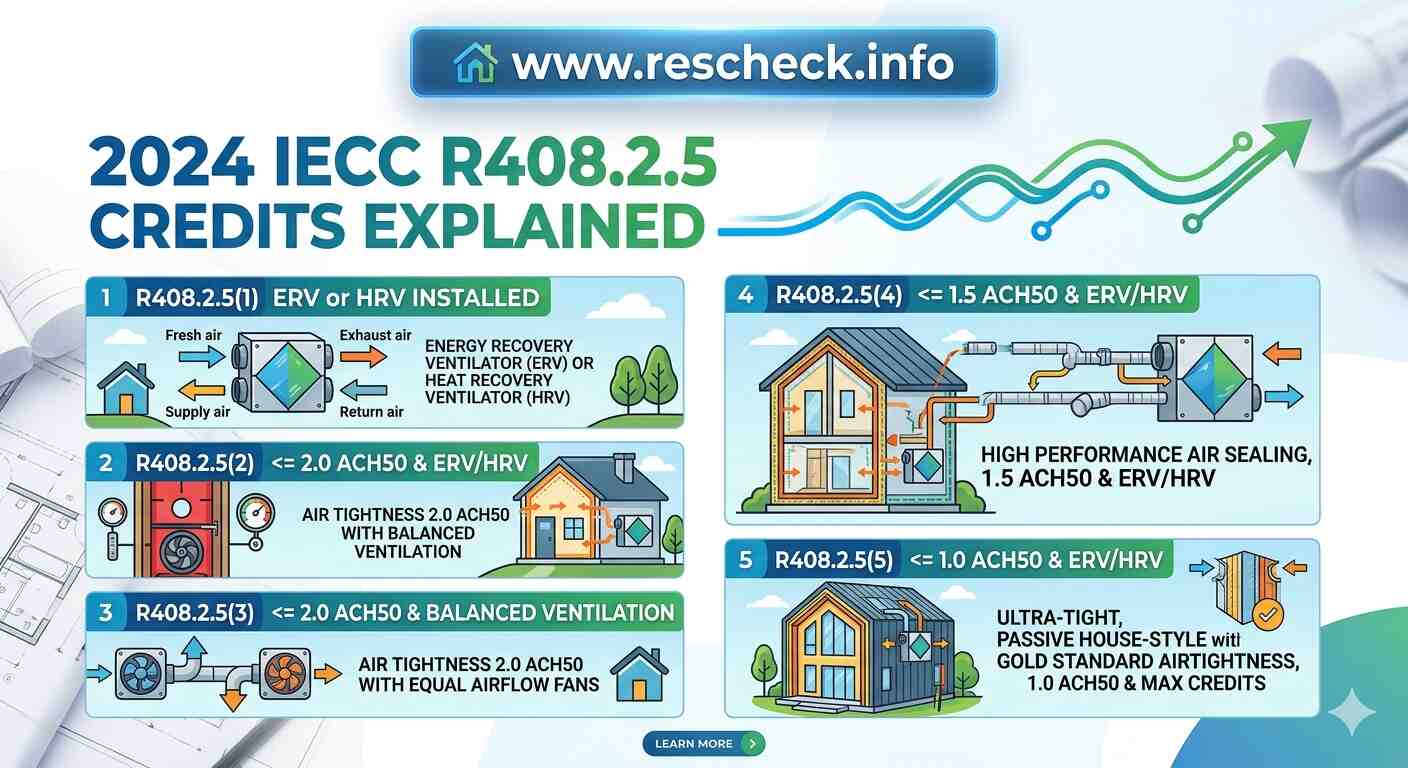
1. R408.2.5(1): ERV or HRV Installed
This is the entry-level credit for mechanical ventilation. To earn this, you must install an Energy Recovery Ventilator (ERV) or a Heat Recovery Ventilator (HRV).
-
What it does: Unlike a standard exhaust fan, these systems exchange stale indoor air for fresh outdoor air while “recovering” the energy (heat or coolness) from the outgoing stream.
-
The Benefit: It ensures fresh air without the massive energy penalty of heating or cooling raw outdoor air.
2. R408.2.5(2): Less than 2.0 ACH50 with ERV or HRV
This credit rewards “building tight and ventilating right.” You must achieve an airtightness of 2.0 Air Changes per Hour (ACH) at 50 Pascals and include an ERV or HRV.
-
Why it matters: 2.0 ACH50 is significantly tighter than the standard code minimum in many zones. By pairing this tightness with an ERV/HRV, you ensure the home doesn’t become “stuffy” while maintaining high thermal efficiency.
3. R408.2.5(3): Less than 2.0 ACH50 with Balanced Ventilation
This is a variation of the previous credit but allows for Balanced Ventilation that isn’t necessarily an ERV or HRV (though they qualify).
-
The Difference: A balanced system uses separate fans to provide equal indoor and outdoor airflow. It doesn’t require the “recovery” element of an ERV/HRV, making it a potentially lower-cost way to hit the 2.0 ACH50 credit if energy recovery isn’t a priority for your climate.
4. R408.2.5(4): Less than 1.5 ACH50 with ERV or HRV
Now we are entering “High-Performance” territory. Achieving 1.5 ACH50 requires meticulous attention to the building envelope (rim joists, top plates, and window flashing).
-
The Payoff: Because the home is so airtight, the ERV/HRV becomes the “lungs” of the house. This combination typically earns a higher point value in REScheck than the 2.0 ACH50 options.
5. R408.2.5(5): Less than 1.0 ACH50 with ERV or HRV
This is the “Gold Standard” for airtightness, often seen in Passive House or Net-Zero builds.
-
The Challenge: Achieving 1.0 ACH50 usually requires advanced sealing methods like aerosol-based sealants or high-performance tapes.
-
The Result: This provides the maximum number of credits available in this category. It represents a home with virtually no uncontrolled air leakage, relying entirely on the high-efficiency ERV/HRV for indoor air quality.
Summary Table: Which Credit Should You Choose?
| Credit ID | Requirement | Key Component | Strategy |
| R408.2.5(1) | ERV/HRV Only | Recovery Vent | Standard build + upgraded vent |
| R408.2.5(2) | $\le$ 2.0 ACH50 | ERV/HRV | Enhanced air sealing |
| R408.2.5(3) | $\le$ 2.0 ACH50 | Balanced Vent | Equal intake/exhaust fans |
| R408.2.5(4) | $\le$ 1.5 ACH50 | ERV/HRV | High-performance air barrier |
| R408.2.5(5) | $\le$ 1.0 ACH50 | ERV/HRV | Precision sealing (Net-Zero style) |
Pro Tip: If you select “None,” you are opting out of these specific ventilation credits. This means you must find your 10 required credits elsewhere—such as through ultra-high efficiency HVAC (R408.2.2) or enhanced insulation (R408.2.1).