Summary
From Ice Blocks to Reschecks: The 250-Year History of American Air Conditioning
From Ice Blocks to Reschecks: The 250-Year History of American Air Conditioning
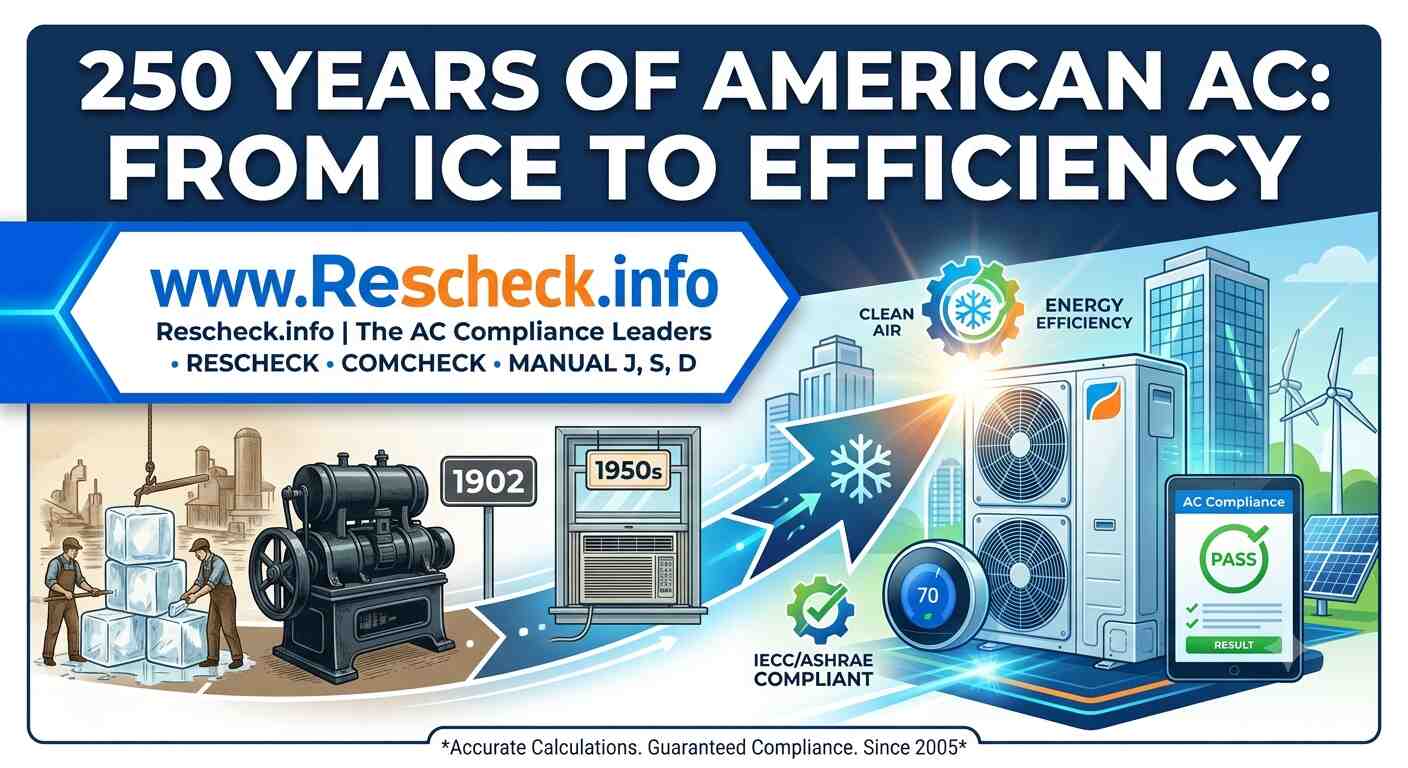
We tend to think of air conditioning as a modern luxury. You come home on a sweltering July afternoon, click a thermostat, and feel an instant wave of relief. But the journey to that effortless cool has been a 250-year-old saga of American innovation.
At Rescheck.info, we spend our days ensuring modern buildings achieve peak energy compliance and precise climate control through Rescheck, Comcheck, and Manual J, S, and D services. To celebrate how far the industry has come, let’s take a journey back to where it all began—long before smart thermostats and duct design software.
1. The Early Sparks (1770s – 1880s)
The foundation of modern cooling actually predates the founding of the United States.
-
1758: Benjamin Franklin and British chemist John Hadley discovered that evaporating highly volatile liquids (like alcohol and ether) could cool down an object past the freezing point of water. They successfully used a bellows to freeze water using ether evaporation.
-
1840s: Dr. John Gorrie, a physician in Florida, pioneered the next major leap. Believing that cold could cure yellow fever, he built a machine that compressed air, then expanded it to cool water and create ice. While he received a patent in 1851, financial backing dried up, and his dream of cooling entire hospitals stalled.
For the rest of the 19th century, “air conditioning” meant one thing: harvesting massive blocks of ice from frozen northern lakes in the winter, insulating them in sawdust, and shipping them south by rail and boat.
2. Industrial Roots & Willis Carrier (1902)
Air conditioning as we know it wasn’t invented to keep humans comfortable; it was invented to fix wrinkly paper.
In 1902, a brilliant young engineer named Willis Carrier was tasked with solving a major crisis at the Sackett & Wilhelms Lithographing & Printing Company in Brooklyn, New York. The summer humidity was causing the paper pages to swell and shrink, making it impossible to align different colored inks properly.
Carrier’s breakthrough design didn’t just cool the air; it controlled humidity. By blowing air across cold pipes, the moisture in the air condensed onto the pipes, leaving the room perfectly dry and cool.
3. The Boom: Theaters, Homes, and the Post-War Rush (1920s – 1950s)
In the 1920s, the public finally got a taste of mechanical cooling. Movie theaters became “cool sanctuaries” during the summer doldrums. Theater owners realized they could pack houses during the slow summer months by installing massive centrifugal chillers, giving birth to the summer blockbuster.
By the 1930s, the technology shrunk. The first window units hit the market, but they were initially priced as luxury items out of reach for the average family.
Following World War II, the economic boom changed everything. Production surged, prices fell, and by the mid-1950s, millions of window units were sold annually. Air conditioning completely reshaped the demographics of the United States, allowing for the rapid growth of Sun Belt cities like Houston, Phoenix, and Miami.
4. The Engineering Revolution: Enter ACCA Manuals
As air conditioning transitioned from a luxury addition to a fundamental piece of building infrastructure, the Wild West era of “guessing” equipment sizes had to end. Contractors used to size systems by simple rules of thumb (like “one ton of cooling per 500 square feet”). This led to oversized equipment, short-cycling, high energy bills, and clammy, humid indoor spaces.
To solve this, the Air Conditioning Contractors of America (ACCA) established scientific standards for residential HVAC design. This protocol completely revolutionized how homes are built and conditioned:
| Protocol | What it Determines | Why it Matters |
| Manual J | Load Calculation | Measures exactly how much heat a house gains in the summer and loses in the winter based on insulation, windows, and orientation. |
| Manual S | Equipment Selection | Uses the Manual J data to select the exact right size HVAC equipment—ensuring it isn’t oversized or undersized. |
| Manual D | Duct Design | Calculates the precise airflow, duct sizes, and static pressures needed to deliver that air quietly and evenly to every room. |
5. The Modern Era: Efficiency & Compliance (2020s & Beyond)
Today, we are no longer just trying to stay cool—we are trying to stay cool efficiently. With modern building codes tightening across the country, building a comfortable home requires a holistic approach where the building envelope and the mechanical systems work in perfect harmony.
This is where Rescheck.info bridges the gap between historical HVAC engineering and modern code enforcement.
To pass inspection today, you don’t just need a contractor who knows how to install an AC unit. You need documented proof that your project complies with energy codes and structural realities:
-
Rescheck & Comcheck: These software compliance reports prove that your residential insulation, windows, and walls (Rescheck) or commercial building systems (Comcheck) meet rigorous state energy codes (like IECC codes).
-
Manual J, S, & D: This complete design package ensures that your HVAC system is engineered specifically for your building’s unique energy profile, matching your Rescheck data perfectly.
Let’s Build the Future Together
We have come a long way from Benjamin Franklin’s glass vials of ether and Willis Carrier’s massive industrial chillers. Air conditioning is now a precise science.
If you are building a new home, planning a commercial space, or navigating a permitted renovation, don’t leave your comfort or code compliance to guesswork. Trust the experts who understand the math behind the history.
Need to get your project permitted and approved? Head over to www.Rescheck.info today. Upload your plans, and our team will deliver fast, accurate Rescheck, Comcheck, and Manual J/S/D calculations to keep your project moving forward smoothly.